



Hey there, car enthusiasts! As a supplier of car radiator fans, I've seen firsthand how crucial it is to pick the right one for your ride. A good radiator fan keeps your engine cool, preventing overheating and potential damage. So, let's dive into how you can choose the perfect car radiator fan.
Understanding Your Car's Requirements
First things first, you need to know your car's make, model, and year. Different cars have different cooling needs, and the radiator fan has to match those requirements. For example, a high - performance sports car might need a more powerful fan compared to a regular sedan.
Your car's engine size also plays a big role. Larger engines generate more heat, so they need a radiator fan with a higher airflow capacity. Check your car's manual or do some online research to find out the specific cooling requirements for your vehicle.
Types of Radiator Fans
There are two main types of radiator fans: mechanical and electric.
Mechanical Fans: These are directly connected to the engine via a belt. They spin at a speed proportional to the engine's RPM. The advantage of mechanical fans is that they're simple and reliable. However, they can sap some engine power, especially at high speeds.
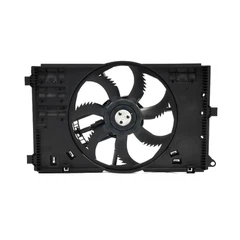
Electric Fans: These are powered by the car's electrical system. They can be controlled independently of the engine, which means they can run even when the engine is off. Electric fans are more energy - efficient and can provide better cooling in stop - and - go traffic. Most modern cars use electric fans because of these benefits.
Fan Size and Airflow
The size of the fan matters a lot. A larger fan can move more air, but it also needs more space. Measure the available space in front of your radiator to determine the maximum fan size you can install.
Airflow is measured in cubic feet per minute (CFM). The higher the CFM, the more air the fan can move. You'll want to choose a fan with a CFM rating that meets or exceeds your car's cooling needs. For example, if you have a small car with a low - power engine, a fan with a CFM of around 1,500 - 2,000 might be sufficient. But for a larger engine or a vehicle that's used for towing, you'll need a fan with a CFM of 3,000 or more.
Fan Blade Design
The design of the fan blades affects how efficiently the fan moves air. There are different blade designs, such as straight, curved, and pitched. Curved and pitched blades are generally more efficient at moving air compared to straight blades.
Also, the number of blades can make a difference. Fans with more blades can move more air, but they also require more power to operate. You'll need to find a balance between airflow and power consumption.
Noise Level
Nobody wants a noisy radiator fan. Some fans are designed to be quiet, while others can be quite loud. If you're sensitive to noise, look for fans that are advertised as "quiet" or "low - noise." You can also read customer reviews to get an idea of how noisy a particular fan is.
Compatibility with Your Car's Cooling System
Your radiator fan needs to be compatible with your car's existing cooling system. This includes the radiator itself, the thermostat, and the coolant hoses. Make sure the fan you choose can be easily installed and integrated with your car's cooling setup.
Brand and Quality
When it comes to car parts, brand and quality matter. Choose a reputable brand that has a good track record of producing reliable radiator fans. A high - quality fan will last longer and perform better than a cheap, low - quality one.


We offer a wide range of high - quality radiator fans for various car makes and models. For example, if you have a Nissan Rogue T33, we have the Nissan Rogue T33 Radiator Fan that is specifically designed to fit your vehicle. Similarly, for Nissan Altima owners, we have the Nissan Altima Radiator Fan, and for Infiniti Q50, the Infiniti Q50 Radiator Fan.
Price
Price is always a consideration when buying a car radiator fan. You don't want to overspend, but you also don't want to buy a fan that's too cheap and might not work properly. Set a budget and look for fans that offer the best value for your money. Remember, a good radiator fan is an investment in the health of your car's engine.
Installation
Some radiator fans are easy to install, while others might require professional help. If you're handy with tools and have some mechanical knowledge, you might be able to install the fan yourself. But if you're not confident, it's best to have a professional do it.
Maintenance
Once you've installed your radiator fan, it's important to keep it well - maintained. Regularly check the fan for any signs of damage, such as bent blades or loose connections. Clean the fan and the radiator to ensure optimal performance.
Conclusion
Choosing the right car radiator fan is not as complicated as it might seem. By considering your car's requirements, the type of fan, size, airflow, blade design, noise level, compatibility, brand, price, installation, and maintenance, you can make an informed decision.
If you're in the market for a car radiator fan, we're here to help. We have a wide selection of high - quality fans that are designed to meet the needs of different cars. Whether you're looking for a fan for a Nissan, Infiniti, or any other make, we've got you covered. Don't hesitate to reach out to us for more information or to discuss your specific requirements. Let's keep your engine cool and your car running smoothly!
References
- Automotive repair manuals
- Online automotive forums
- Manufacturer's specifications for car radiator fans


