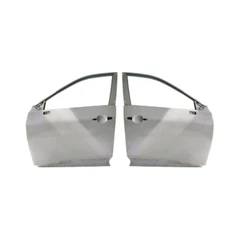

As a crucial component of the car body, car doors serve not only as passageways for occupants but also as key structural components ensuring passenger safety, comfort, and the overall functional integrity of the vehicle. In the overall automotive design, car doors not only fulfill basic passage functions but also integrate multiple functions such as protection, sound insulation, sealing, aesthetics, and intelligent control. Their technological content and manufacturing standards directly impact the overall vehicle quality and market competitiveness.
Structurally, car doors typically consist of outer panels, inner panels, window frames, reinforcing beams, hinges, door locking mechanisms, and sealing strips. Outer panels are often made of high-strength steel or aluminum alloy sheets, stamped to meet styling and strength requirements. The inner panel serves as both a load-bearing structure and mounting platform, used to secure interior trim components, electrical modules, and seatbelt anchor points. Reinforcing beams are mostly located within the door cavity; through reasonable routing and cross-sectional design, they enhance energy absorption and occupant protection during side collisions. Window frames work in conjunction with the window lifting mechanism to open and close the windows, while sealing strips ensure waterproofing, dustproofing, and sound insulation between the door and the vehicle body when closed.
The primary function of car doors is safety. Modern car doors play a crucial role in side-impact collisions, protecting the vehicle from external impacts and maintaining occupant survival space. Their structural strength and energy absorption characteristics must meet stringent regulatory requirements. Door locking systems have evolved from mechanical locks and centrally controlled electric locks to smart locks with anti-pinch, remote control, and anti-theft alarms, continuously improving ease of use and security levels. Hinge design must ensure sufficient durability and load-bearing capacity, maintaining door stability under frequent opening and closing and long-term loads, preventing sagging or abnormal noise.
Comfort and functionality also play a vital role in car door design. Door interiors integrate armrests, storage compartments, speakers, and electronic switches, providing occupants with convenient operation and a comfortable riding experience. The application of sound and heat insulation materials effectively reduces external noise and heat transmission, improving cabin quietness and temperature control efficiency. In high-end models, doors can feature keyless entry, electric soft-close, automatic welcome lights, and ambient lighting synchronization, showcasing a human-centered and technologically advanced design.
Sealing and protective performance are crucial to the overall vehicle durability and environmental adaptability. The multi-layered sealing structure between the door and the body prevents rainwater infiltration, dust intrusion, and pressure difference noise during high-speed driving. Combined with drainage holes, it promptly removes accumulated water, preventing internal corrosion. For different climatic conditions and operating environments, the door materials and coatings must possess corrosion resistance, UV resistance, and high and low temperature resistance to ensure long-term reliability.
In terms of manufacturing processes, door production encompasses stamping, welding, painting, and final assembly, making precision control and consistency assurance particularly important. With the advancement of lightweighting and electrification, aluminum alloy doors, carbon fiber composite doors, and modular sub-assembly technologies are gradually being adopted, reducing weight and shortening assembly time while meeting performance requirements.
Overall, car doors in an automotive system possess comprehensive attributes, including structural safety, ease of passage, comfort, and aesthetic expression. Their design and manufacturing must comprehensively consider mechanical performance, functional integration, environmental adaptability, and user needs. Continuous technological innovation and process optimization provide solid support for improving overall vehicle safety, quality, and market competitiveness.