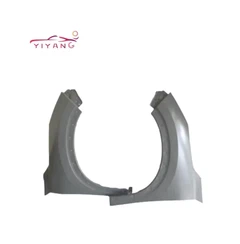

While mudguards are often considered aesthetic and auxiliary components in automotive body systems, their design embodies clear engineering logic and functional objectives.As a protective barrier between the wheel and the body, the core mission of mudguards is to effectively suppress the splashing of mud, sand, and debris kicked up by the tires through reasonable geometry, material selection, and fixing methods. This protects the body panels, chassis components, and the surrounding environment from erosion and impact, while also considering aerodynamic optimization and driving safety in certain scenarios. Understanding their design principles helps achieve a balance between protection, adaptability, and economy in development and application.
Mudguard design primarily follows the laws of fluid and particle motion. During tire rolling, the tread grooves continuously discharge accumulated water and fine particles, which are then propelled at high speed tangentially under centrifugal force. The design requires calculating the initial velocity and trajectory envelope of the splashing material based on the tire diameter, width, tread pattern, and typical vehicle speed. This determines the radial extension length, longitudinal coverage angle, and installation height of the mudguard, ensuring that the splashing material is intercepted and guided downwards or outwards before reaching the vehicle body. Curved or tapered cross-sections not only expand the interception range but also reduce turbulent drag under airflow, preventing the formation of new vortex zones.
Structurally, mudguards must strike a balance between protection and space constraints. Front wheel mudguards are often integrated with fenders or wheel arch liners, using a compact structure to cover a larger turning radius and prevent tire-mudguard interference during cornering. Rear wheel mudguards, on the other hand, prioritize suspension travel and tire vertical movement margins, employing segmented or deformable designs to ensure they do not contact the tire during compression and rebound. Edge contours are often designed to be streamlined or serrated; the former reduces high-speed wind resistance, while the latter disperses airflow pulsations and reduces noise transmission into the cabin.
Material selection reflects a comprehensive consideration of strength, weight, and durability. Steel stampings offer high strength and impact resistance, making them suitable for commercial vehicles and off-road vehicles, but they are relatively heavy. Engineering plastics (such as polypropylene (PP) and acrylonitrile-butadiene-styrene copolymer (ABS)) are lightweight, tough, and easily molded into complex curved surfaces, facilitating integration with vehicle body styling, and are widely used in passenger vehicles. Composite materials provide excellent weather resistance and chemical corrosion resistance in high-end or extreme environments. Surface treatments, such as UV-resistant coatings or fiber reinforcement, can delay aging and extend service life.
The fixing and installation principles emphasize reliability and maintainability. Mudguards are typically rigidly connected to the vehicle body or suspension brackets via bolts, supplemented by elastic clips to absorb vibration and prevent loosening due to fatigue during long-term driving. The installation position must maintain a suitable distance from the wheel axis to avoid interference under extreme conditions, while ensuring easy disassembly for maintenance and replacement.
In terms of functional expansion, modern design also incorporates noise reduction and aerodynamic optimization. Adjusting the mudguard curvature and opening shape through CFD simulation can reduce tire noise transmission into the vehicle interior and smooth airflow separation at high speeds, reducing the overall vehicle drag coefficient and indirectly improving fuel economy.
In summary, the design principle of automotive mudguards is based on the control of mud splash trajectory, integrating structural space adaptation, material performance matching, and multi-objective optimization to construct a functional system that combines protection, noise reduction, and safety. By scientifically applying these principles, efficient and reliable mud protection can be achieved in different vehicle models and operating environments, providing solid support for vehicle durability and overall vehicle performance.