
In automotive thermal management systems, radiator fans play a crucial role in enhancing airflow and improving engine cooling efficiency. Their performance directly impacts the vehicle's operational stability and fuel economy under high-temperature conditions. As an active ventilation device between the cooling circuit and the external environment, this component must maintain reliable operation under complex road and climatic conditions, thus exhibiting unique technical characteristics and operational requirements in its design, selection, and use.
The core function of automotive radiator fans is to rapidly remove heat from the radiator surface through forced convection, lowering the coolant temperature and preventing engine overheating. Compared to air-cooled systems relying on natural convection, fans significantly increase airflow and heat transfer coefficient per unit time, thereby maintaining appropriate cooling intensity during low-speed driving, idling, or high-temperature environments. Their operating modes are generally divided into two categories: constant speed and variable speed. The former is simple in structure and low in cost, and is mostly used in basic models; the latter relies on temperature control switches, electronic control units, or pulse width modulation signals to dynamically adjust the speed according to coolant temperature, vehicle speed, and air conditioning load to achieve a balance between energy efficiency and heat dissipation.
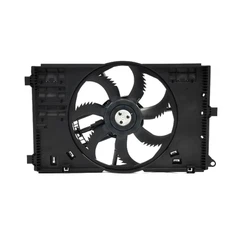
Structurally, automotive radiator fans mostly employ an axial flow design with helical blades, achieving a large airflow within a relatively small axial dimension. Material selection balances strength, temperature resistance, and lightweight requirements, commonly using engineering plastics, glass fiber reinforced resin, or aluminum alloys, which reduce rotational inertia while providing good corrosion resistance and vibration resistance. Motor drive methods include various types such as brushed DC, brushless DC, and electronic speed control. Among these, brushless motors are increasingly popular in high-end and new energy vehicles due to their long lifespan, low noise, and excellent speed control linearity. The assembly of the fan with its protective ring and vibration damping pads requires strict control of dynamic balance to reduce vibration and noise during high-speed operation and minimize interference with surrounding piping and electronic components.
Operational control strategies are an important extension of fan technology. Traditional temperature control switches rely on bimetallic strips to sense temperature changes and control start/stop, which suffers from response lag and limited accuracy. Modern vehicles generally use engine control units (ECUs) or battery thermal management systems (BTMS) for integrated control, combining multiple temperature sensors and vehicle speed signals to achieve on-demand start/stop and multi-level speed adjustment, thereby reducing unnecessary energy consumption and noise emissions. In new energy vehicles, the fan also needs to meet the heat dissipation requirements of the motor controller and power module, making the control logic more complex and placing higher demands on response speed and reliability.
In terms of maintenance, the fan blades should be regularly inspected for cracks, deformation, or foreign matter to ensure that dynamic balance and aerodynamic performance are not affected; the motor and bearing housings should be cleaned to prevent dust and oil from causing poor heat dissipation or rotational obstruction; circuit connections and relay contacts should be checked to eliminate unstable speed or failure to start caused by increased contact resistance. Abnormal noise, sluggish speed, or stalling are often signs of bearing wear, motor winding failure, or control module malfunction, requiring timely troubleshooting and repair to avoid affecting the overall vehicle thermal management safety.
Although automotive radiator fans are auxiliary components, they play an irreplaceable role in ensuring the operating temperature range of the engine and key electronic devices. Their technological development shows a trend towards efficient aerodynamic design, intelligent speed regulation, and long service life. Through deep integration with the vehicle's thermal management system, they provide solid support for improving operational reliability, reducing energy consumption, and optimizing the driving experience.