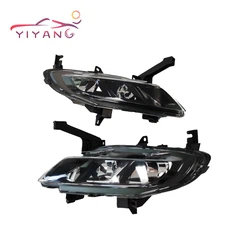

As a critical component for safe vehicle operation and signal transmission, the quality of automotive lighting directly impacts driving safety and traffic order at night and in low-visibility conditions.To ensure that automotive lighting can stably and reliably perform its illumination and indication functions under various operating conditions, systematic and meticulous quality control must be implemented throughout the entire lifecycle of R&D, production, and after-sales service, covering design verification, raw material control, process monitoring, finished product testing, and continuous tracking.
In the design verification phase, quality control begins with a comprehensive assessment of optical performance, structural strength, and environmental adaptability. Optical verification requires adherence to national and international light distribution standards. A high-precision light distribution testing system is used to measure the illuminance, beam pattern, and color temperature of low beam, high beam, turn signals, and brake lights, ensuring that the beam coverage and cutoff lines meet safety requirements. Structural verification utilizes finite element analysis (FEA) and vibration testing to verify the reliability of the lamp body, bracket, and heat dissipation module under driving impacts and long-term vibrations. Environmental adaptability verification includes high and low temperature cycling, damp heat aging, salt spray corrosion, and dust and water resistance tests to confirm the durability of the lamp housing, seals, and electronic components in extreme climates and road environments. Prototype parts also require real-vehicle road testing to collect usage data under different road conditions and weather conditions, serving as a basis for design iteration.
Quality control of raw materials and components is fundamental to ensuring the consistency of the finished product. The polycarbonate or acrylic resin used for the lamp housing must pass tests for melt flow index, light transmittance, impact strength, and weather resistance; the reflector cup and lens materials should reach optical-grade purity and undergo surface defect and curvature accuracy inspection; key electronic components such as LED chips, driver modules, and sensors must be sourced from qualified suppliers, and an incoming material sampling inspection and batch traceability system must be implemented to ensure that their photoelectric parameters, operating temperature range, and lifespan meet design requirements. All materials must be accompanied by an authoritative testing report and a unique code before being put into storage to facilitate rapid source identification in case of anomalies.
Process monitoring is implemented throughout key processes such as injection molding, optical assembly, electronic welding, and sealing curing. In the injection molding process, mold temperature, injection pressure, and cooling time must be strictly controlled to prevent shrinkage marks, weld lines, or stress concentration. The optical assembly process requires high-precision positioning fixtures and automatic alignment equipment to ensure that the relative positional errors of the reflector, lens, and light source are within acceptable limits. Electro-soldering must be performed with anti-static measures and temperature profile management to avoid incomplete soldering, cold soldering, and thermal damage to components. The sealing process requires monitoring of the adhesive thickness and curing conditions to ensure the lamp cavity meets the specified dustproof and waterproof rating (e.g., IP67/IP68). Online inspection stations should be equipped with automated optical inspection (AOI) and electrical performance testing equipment to instantly assess the output of each process, immediately isolating any abnormal products and initiating corrective measures.
Finished product inspection is the final checkpoint for quality control. In addition to repeating critical light distribution and color temperature tests, it is also necessary to perform lighting function checks, dimming response time measurements, dimming motor operation accuracy verification, and communication protocol compatibility testing (for vehicle lights with intelligent control functions). Environmental reliability sampling should include aging tests and high/low temperature shock tests to verify long-term stability. All testing data must be incorporated into the quality information system to form complete batch files, supporting recall analysis and continuous improvement.
After-sales quality tracking and data analysis are equally crucial components of the system. By collecting market feedback, failure modes, and lifespan statistics, potential design weaknesses or supply chain fluctuations can be identified, driving design optimization and supplier audit upgrades. Regular internal audits and management reviews ensure that quality control processes are updated in line with the latest regulations and technical standards, forming a self-improving closed-loop mechanism.
Overall, automotive lighting quality control is a cross-disciplinary, end-to-end systematic project. Only by strictly implementing standards and data-driven management in all aspects-design verification, material management, process monitoring, finished product testing, and continuous improvement-can products meet stringent requirements in terms of safety, reliability, and durability, providing a solid guarantee for driving safety.