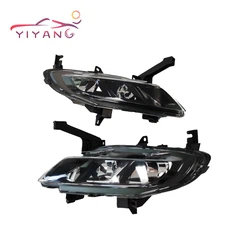

Vehicle lights are core devices for nighttime driving, navigating in adverse weather conditions, and signal transmission. Their proper use and maintenance directly impact driving safety and equipment lifespan. Through long-term practice and professional maintenance, a series of operational techniques have been developed, covering daily use, testing and debugging, cleaning and maintenance, and upgrades, providing systematic practical guidance for drivers and maintenance personnel.
Regarding daily use techniques, the primary principle is to select the appropriate lighting mode based on environmental and traffic conditions. On roads without streetlights at night, high beams should be used to maximize illumination. However, when encountering oncoming vehicles or pedestrians/non-motorized vehicles ahead, low beams must be switched promptly to avoid glare that could impair others' vision. In rainy or foggy weather, low beams, side marker lights, and front and rear fog lights should be used. Fog lights have strong penetrating power, improving visibility and alerting surrounding vehicles. However, high beams should not be used alone, as the light is easily scattered by water droplets, reducing visual clarity. Before turning or changing lanes, activate your turn signal in advance for at least three seconds to allow vehicles behind and to the side sufficient reaction time. When parked or temporarily off, avoid leaving headlights (especially halogen lights) on for extended periods to prevent battery drain. If necessary, use parking lights or the engine-off delay-off function.
Inspection and adjustment techniques help maintain the accuracy of headlight patterns and illumination range. Regularly check the height and symmetry of low and high beams on a flat surface. The low beam cutoff should be slightly below eye level to avoid directly shining on oncoming drivers; the high beam center point should coincide with the center line of the vehicle's front and have sufficient illumination distance. If you find any deviation in beam pattern, brightness decrease, or asymmetry, correct it promptly using the adjustment screws or motor calibration mechanism. Do not attempt to grind the reflector bowl or replace it with inferior bulbs, as this may disrupt the optical design balance. For vehicles equipped with automatic headlights and adaptive high beam systems, perform periodic sensor cleaning and functional self-testing to ensure proper light intensity sensing and environmental recognition logic.
Cleaning and maintenance techniques focus on maintaining light transmittance and the integrity of the vehicle's appearance. The surface of the lamp housing is prone to accumulating insect residue, mud, acid rain residue, and UV aging layers. It should be wiped regularly with a neutral detergent and a soft cloth. Avoid using hard-bristled brushes or strong acid/alkali solutions to prevent scratching or corroding the polycarbonate material. For lamp housings exhibiting fogging, check for aging seals or blocked vents. Replace seals if necessary and dry them to prevent short circuits in the internal circuitry. For vehicles parked for extended periods, cover them with dust covers and regularly check the tightness of wiring terminals to prevent oxidation and poor contact.
Upgrade and adaptation techniques must balance regulatory compliance and system compatibility. When replacing the light source, choose a model that matches the lamp's optical design. For example, LED bulbs must correspond to the focal parameters of the reflector or lens; otherwise, it may cause scattered light patterns or excessive glare. Xenon headlight retrofits require matching ballasts and lenses, and beam recalibration to ensure compliance with motor vehicle safety technical standards. Adding auxiliary lights (such as spotlights and work lights) should be strategically positioned and angled to avoid interfering with your own or others' vision. Ensure proper waterproofing of the electrical circuitry and use independent switches to prevent overload from affecting the vehicle's power supply.
In general, vehicle lighting usage and maintenance techniques encompass four aspects: correct operation, regular inspection, meticulous cleaning, and compliant upgrades. Mastering and practicing these techniques not only maintains optimal lighting performance and extends the lifespan of your lights but also provides reliable safety assurance in complex weather and road conditions, reflecting the driver's professionalism and vehicle management skills.