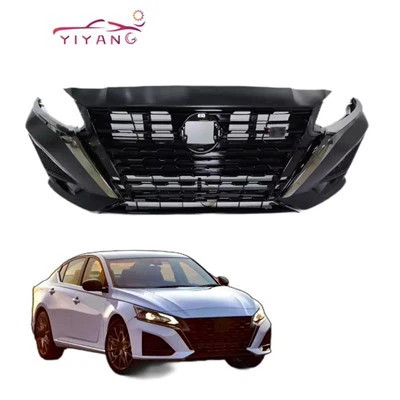



Automotive body kits are not isolated cosmetic components. Their functional foundation relies on the systematic integration of principles from multiple disciplines, including aerodynamics, structural mechanics, materials science, and vehicle adaptability. This aims to provide verifiable physical support for vehicle performance optimization, safety assurance, and form shaping. A deep understanding of this foundation is key to grasping the core value of body kits from design to application.
Aerodynamic efficiency is one of the most crucial functional foundations of body kits. When a vehicle is in motion, the interaction between airflow and the body directly affects drag, lift, and stability. The front lip reduces drag by narrowing the airflow channel at the front, reducing low-pressure areas formed by airflow separation; the side skirts guide airflow longitudinally along the body, suppressing lateral vortices and mitigating the impact of lift on tire grip; the rear diffuser, by increasing the cross-sectional area of the bottom airflow outlet, accelerates airflow expulsion, balances the pressure difference between the undercarriage and roof, and further enhances high-speed stability. Such designs require CFD (Computational Fluid Dynamics) simulations and wind tunnel testing to ensure that airflow field adjustments meet engineering expectations, rather than relying solely on styling intuition.
Structural mechanics support is the foundation for the functional sustainability of body kits. External body panels must withstand aerodynamic loads, vibrations, and minor impacts during operation. They often incorporate reinforcing ribs, honeycomb structures, or metal anti-collision beams, using topology optimization to distribute stress and prevent localized deformation or fracture. Aerodynamic components (such as the tail fin) require airfoil cross-sections that meet lift/downforce coefficient requirements at specific angles of attack. Material selection and structural reinforcement (such as the layup direction design of carbon fiber laminates) ensure morphological stability under extreme conditions.
Advances in materials science provide the material foundation for functional performance. Carbon fiber composites, with their high specific strength and low density, maintain structural stiffness while reducing weight, meeting high-performance requirements. Glass fiber reinforced plastics (FRP) balance functionality and price in the mass market due to their low cost and ease of molding. Engineering plastics (such as ABS) excel in weather resistance and impact resistance, making them suitable for everyday use. The selection of different materials must be precisely matched to functional objectives-for example, diffuser edges, which need to withstand high-frequency airflow impacts, prioritize materials with better toughness; while weight-sensitive high-mounted tail fins tend to favor carbon fiber solutions.
Vehicle compatibility is a crucial prerequisite for the successful implementation of functional components. The structural parameters of the kit (such as mounting holes and contour curvature) must closely match the original vehicle body CAD model to avoid airflow disturbances, sensor obstruction, or safety feature malfunctions due to installation deviations. Modular interface design and parametric modeling technology enable seamless integration of the kit with the original structure, ensuring that functional gains do not sacrifice the vehicle's original performance and safety.
In summary, the functional foundation of automotive body kits is the result of the synergistic effect of aerodynamic optimization, structural mechanical reinforcement, material property matching, and vehicle compatibility. This underlying logic not only supports the evolution of kits from "decorative parts" to "functional parts" but also defines their indispensable technical position in modern automotive engineering.