
As the core device for vehicle illumination and signal transmission, automotive lighting is not simply a combination of a light source and a housing, but a systematic engineering architecture based on optical principles, material properties, and functional requirements. A deep understanding of automotive lighting structure helps to grasp the evolutionary logic of modern automotive lighting technology in terms of safety, energy efficiency, and intelligence.
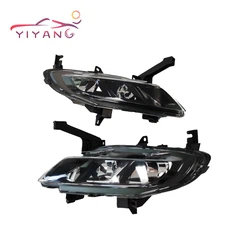
From a core component perspective, automotive lighting structures are generally divided into four main modules: the optical system, the heat dissipation system, the drive control system, and the external protective housing. The optical system is the "heart" of the lighting system, responsible for light generation and directional projection. Taking LED low beams as an example, its core consists of an LED chip array, a reflector (or lens), and a light shield: the chip array generates high-brightness white light through current excitation; the reflector uses a parabolic or freeform surface design to reflect scattered light into parallel or specific angle beams; and the light shield precisely cuts the upper edge of the light beam to avoid glare for oncoming drivers. High beam structures eliminate or simplify the light shield and further converge the light through lenses, expanding the illumination range and intensity. Laser headlights employ a more sophisticated optical system, requiring a phosphor converter to transform the laser light into uniform white light, which is then projected precisely over long distances via a multi-layered lens array. This results in significantly higher structural complexity and precision requirements compared to traditional light sources.
The heat dissipation system is crucial for ensuring stable optical performance. Both LED and laser light sources are extremely sensitive to temperature; high temperatures accelerate light decay and shorten lifespan. Therefore, the headlight structure must integrate both active and passive cooling solutions: passive cooling relies on an aluminum alloy lamp body or a thermally conductive substrate, increasing surface area to accelerate heat dissipation; active cooling uses micro-fans or thermoelectric cooling modules to force heat dissipation during high-power output. Some high-performance headlights also integrate the heat sink fins with the lamp body design, ensuring airflow while maintaining lightweight and aesthetic appeal.
The drive control system forms the structural foundation for intelligent headlights. This module integrates a power management chip, microprocessor, and communication interface, responsible for adjusting the light source current to achieve brightness levels (such as adaptive high/low beam switching), timing control (such as sequential turn signals), and fault diagnosis. Electromagnetic compatibility (EMC) must be considered in the structural design. Shielding layers and filtering circuits reduce interference from high-frequency signals to the vehicle's electronic systems, while reserving CAN bus or Ethernet interfaces for real-time data exchange with the vehicle's intelligent driving system.
The external protective housing is the first line of defense against environmental corrosion. Housing materials are mostly polycarbonate (PC) or acrylic resin (PMMA). The former offers high impact resistance and heat resistance, while the latter boasts superior light transmittance (up to 92% or more). The housing structure must meet IP67/IP68 dust and water resistance standards, achieving a seamless seal through ultrasonic welding or sealing rings. The surface is often treated with a hardened coating to enhance scratch resistance and UV aging resistance. Furthermore, the housing shape must be coordinated with the vehicle's aerodynamic design, using air ducts or spoiler structures to reduce wind resistance and rainwater adhesion during driving, preventing fogging inside the lamp cavity.
Another significant feature of modern automotive lighting structures is modularity and scalability. For example, matrix LED headlights integrate multiple independent light-emitting units onto a single substrate, achieving dynamic beam avoidance (such as tracking and blocking oncoming vehicles) by controlling the switching of each unit. Adaptive Front-lighting Systems (AFS) adjust the projection angle of the entire optical module via a rotating motor; the structural design must reserve space for motor mounting and transmission clearance to ensure operational accuracy and durability.
In summary, automotive lighting structures are a deep integration of optical design, thermal management, intelligent control, and environmental protection technologies. Every detail-from chip packaging to housing curvature, from heat sink fin layout to communication protocol adaptation-aims to improve lighting efficiency, safety, and reliability, reflecting the engineering wisdom of automotive lighting in its transition from "functional implementation" to "system intelligence."