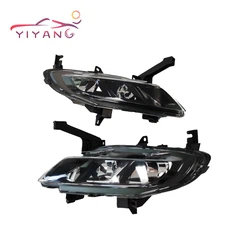

Headlight design is not merely about aesthetic sculpting or light source arrangement, but a systems engineering philosophy seeking the optimal balance between safety, functionality, aesthetic expression, and the trend towards intelligence. Its core concept can be summarized as "function priority, technology-driven, aesthetic synergy, and scenario adaptation," with these four elements mutually supporting each other and jointly shaping modern headlights from simple lighting devices into intelligent interactive nodes.
Function priority is the fundamental starting point for headlight design. Lighting performance must meet the requirements of visibility and being seen in all weather and road conditions. This requires precise control of light pattern, illuminance, and color temperature in the optical structure to ensure that low beams effectively illuminate the road ahead without glare, and high beams expand the field of vision without endangering oncoming traffic. Signal indication functions require clear brightness levels, flashing frequencies, and color definitions to ensure that intentions such as turning, braking, and warnings can be quickly identified. Design must optimize beam distribution and projection angle while meeting regulatory light distribution standards, ensuring drivers have a clear and uniform field of vision at night, in rain, fog, or dusty environments. This is the cornerstone of all aesthetic and intelligent expansion.
Technological advancements drive the continuous evolution of automotive lighting design. Iterative developments in light source technology propel structural innovations-from the spherical emission of halogen lamps to the directional projection of xenon lamps' arc discharge, and then to the semiconductor array of LEDs and the high-power directional excitation of lasers. Each technological leap brings reduction in size, improved energy efficiency, and faster response speeds, allowing designers to achieve more complex light pattern programming and dynamic effects within limited space. Advances in heat dissipation technology, drive circuits, and intelligent control algorithms enable intelligent functions such as adaptive high beams, matrix-style shielding, and adaptive headlights. Automotive lights have evolved from passive illumination to actively sensing the environment and adjusting output in real time, becoming the interface for information interaction between the vehicle and the outside world.
Aesthetic harmony reflects the finishing touch role of automotive lights in the overall vehicle styling language. As the visual focal point of the front and rear, the headlight contours, lamp cavity segmentation, and light source arrangement must echo the body lines and brand DNA. Sharp lines convey a sense of sportiness and technology, while rounded curves accentuate elegance and approachability. Daytime running lights, fiber optics, or microlens arrays within the headlight assembly create a unique brand identity through light and shadow layers and lighting sequences, ensuring the headlights remain recognizable even when off. The design must maintain aerodynamic integrity, avoiding increased wind resistance or disrupted proportions for the sake of visual appeal, achieving a harmonious balance between form and performance.
Scenario adaptability emphasizes the responsiveness of headlight design to different usage environments and user needs. Urban commuter vehicles prioritize low glare and high uniformity to ensure courtesy in dense traffic; off-road or long-distance vehicles require enhanced high beam range and protective structures to cope with unpaved roads and variable weather; in the era of intelligent driving, headlights need to reserve space for sensor integration and communication interfaces to enable synergy between lighting and sensing functions, such as overlaying navigation arrows and speed limit signs onto projection headlights to improve road interaction efficiency. The modular design concept also allows for the development of multiple headlight designs from the same platform, quickly responding to the needs of specific market segments.
In terms of sustainability and regulatory compliance, the design philosophy must also incorporate the selection of environmentally friendly materials, energy efficiency optimization, and global regulatory compatibility. Utilizing recyclable optical materials, low-power light sources, and efficient heat dissipation structures can reduce the environmental impact throughout the entire lifecycle. While meeting ECE, SAE, and GB standards for light distribution and safety, the design also considers the access requirements of emerging markets for intelligent lighting functions, ensuring its universality and forward-looking nature.
Overall, the design philosophy of automotive lights is based on functional realization, driven by technological innovation, expressed through aesthetic language, and extended by scenario adaptation, continuously iterating within the framework of regulations and sustainability. Guided by this philosophy, automotive lights are not merely tools for illuminating the road ahead, but also mobile terminals integrating safety, intelligence, and human-centered design, continuously leading the evolution of automotive styling and interaction methods.