
Automotive lighting is not merely a functional component in automotive engineering and transportation systems; it also embodies interdisciplinary scientific value.Its research and application involve fields such as optics, materials science, thermodynamics, electronic engineering, human-computer interaction, and intelligent sensing, reflecting humanity's systematic scientific exploration in improving traffic safety, expanding environmental adaptability, and promoting intelligent transportation.
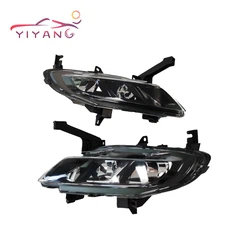
From the perspective of optical principles, automotive lighting is a typical research object for the directional projection and beam control of artificial light sources. Early halogen lamps, based on the principle of thermal radiation, emitted light through heating a tungsten filament. While their spectrum was continuous, their energy efficiency was low, driving research into new light sources such as gas discharge (xenon lamps) and semiconductor light emission (LEDs, lasers). LEDs utilize the quantum effect of carrier recombination to emit light, possessing advantages such as high brightness, fast response, and small size. The optical system design of LEDs needs to address issues such as light distribution uniformity, color temperature stability, and glare suppression in multi-chip arrays, which has promoted the theoretical development of non-imaging optics, freeform surface design, and microstructure optical elements. Laser headlights further incorporate fluorescence conversion and beam shaping technologies, combining the high directionality of lasers with the broad-spectrum emission of phosphors to achieve ultra-long-distance, high-visibility illumination, providing a scientific paradigm for the safe application of extremely bright light sources.
Thermodynamics research is equally crucial to the scientific significance of automotive lighting. High-power light sources generate a large amount of heat during operation; if this heat cannot be effectively dissipated, it will lead to accelerated light decay, shortened lifespan, and even device failure. Automotive headlight heat dissipation design integrates the three basic heat transfer methods of conduction, convection, and radiation, promoting the application research of micro heat pipes, thermoelectric cooling, high thermal conductivity composite materials, and biomimetic heat dissipation structures (such as sharkskin-textured fins). These achievements not only improve the thermal stability of automotive headlights but also provide a reference for the thermal management of other high heat flux density electronic devices.
Materials science lays the material foundation for improving automotive headlight performance. Transparent lamp housing materials need to maintain high light transmittance while possessing impact resistance, weather resistance, and UV aging resistance. The development of molecular structure modification of polycarbonate and acrylic resins, surface hardening coating technology, and nanocomposite scratch-resistant coatings all stem from a deep understanding of the relationship between the microstructure and macroscopic properties of materials. Furthermore, the optical purity, temperature resistance, and molding precision of reflector cups and lens materials also rely on advancements in metallurgy and precision machining science.
Advances in electronic engineering and intelligent control have enabled vehicle lighting to shift from passive illumination to active sensing and adaptive adjustment. High-speed response and constant current control technology in drive circuits ensure stable light source output; embedded systems and sensing algorithms enable dynamic and automatic switching of light patterns based on ambient light, vehicle speed, road conditions, and traffic participants, involving the integrated application of machine vision, pattern recognition, and real-time control theory. Matrix LEDs and pixelated headlights go a step further, combining lighting with image projection, providing an experimental platform for vehicle-to-everything (V2X) interaction and road information enhancement, and driving the development of in-vehicle optoelectronic information systems.
At the level of traffic science and public safety, vehicle lighting research reveals the laws of human factors engineering and visual perception. The impact of different color temperatures, brightness, and light patterns on driver reaction time, visual fatigue, and nighttime visibility provides experimental evidence for developing reasonable light distribution standards and lighting usage specifications. Adaptive lighting systems improve visual comfort in multi-vehicle encounters and complex road conditions by reducing glare and enhancing target contrast; this is essentially based on environmental adaptation research in human visual neuroscience.
The scientific significance of automotive lighting also lies in interdisciplinary collaborative innovation. It is both at the forefront of light source physics and optoelectronics applications and a crucial node in vehicle-to-infrastructure (V2I) communication and autonomous driving perception within Intelligent Transportation Systems (ITS). For example, the integration of automotive lighting with millimeter-wave radar and cameras allows vehicles to acquire environmental data while illuminating, achieving a closed loop of "lighting-perception-decision," which lays the technological foundation for future intelligent road V2I lighting networks.
In conclusion, the research and application of automotive lighting embodies multidisciplinary scientific exploration. Its scientific significance lies not only in improving the performance of individual components but also in promoting theoretical progress and technological innovation in fields such as optics, thermal management, materials, electronics, and intelligent transportation, providing solid scientific support for creating a safer, more efficient, and intelligent travel environment for humanity.